
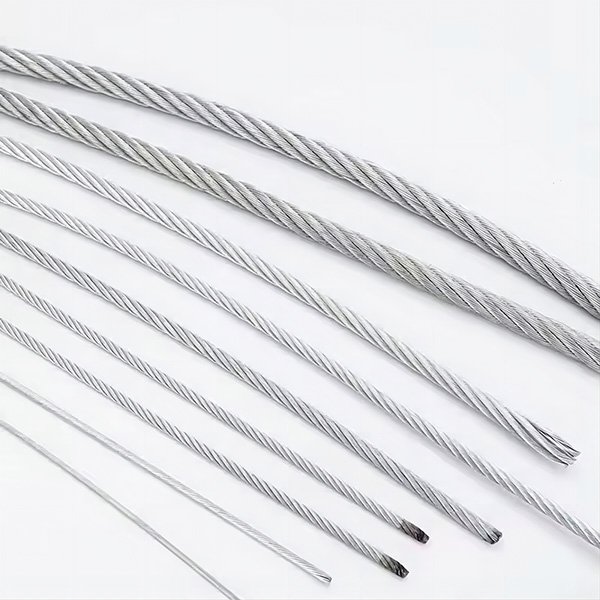
Choosing the right stainless steel wire rope requires more than simply selecting a diameter. Material grade, wire rope construction, flexibility, corrosion resistance, working load and installation environment all affect performance and service life.
Stainless steel wire rope is widely used in cable railing, marine rigging, architectural systems, safety cables, industrial equipment and general engineering applications.
This guide explains how to compare 304, 316 and 316L stainless steel, understand common constructions such as 1×19, 7×7 and 7×19, and select a suitable specification for your application.
Quick Selection Guide
| Application / Requirement | Common Starting Point |
|---|---|
| General architectural use | AISI 304 |
| Marine or coastal environment | AISI 316 |
| Welded assemblies or applications requiring low-carbon stainless steel | AISI 316L |
| Cable railing / balustrade | 1×19 |
| General flexible cable | 7×7 |
| Applications requiring greater flexibility | 7×19 |
| Safety and small cable assemblies | 7×7 / 7×19 |
| Corrosive outdoor environment | AISI 316 |
These are general recommendations only. Final selection should also consider load, diameter, fittings, installation method and applicable safety requirements.
What Is Stainless Steel Wire Rope?
Stainless steel wire rope is produced by arranging individual stainless steel wires into strands or cable constructions.
Different constructions change the flexibility, strength and handling characteristics of the finished cable.
Common stainless steel grades include:
- AISI 304
- AISI 316
- AISI 316L
Common constructions include:
- 1×7
- 1×19
- 7×7
- 7×19
- 6×19
- 6×37
Compared with ordinary uncoated carbon steel wire rope, stainless steel provides excellent corrosion resistance and a clean appearance, making it particularly suitable for architectural, outdoor and marine applications.
304 vs 316 vs 316L Stainless Steel Wire Rope
Material grade is one of the most important factors when selecting stainless steel wire rope.
| Grade | Corrosion Resistance | Typical Applications |
|---|---|---|
| AISI 304 | Good | General architectural and industrial applications |
| AISI 316 | Higher resistance to chloride environments | Marine, coastal and outdoor applications |
| AISI 316L | Similar corrosion performance to 316 with lower carbon content | Welded assemblies and specialized applications |
AISI 304 Stainless Steel Wire Rope
AISI 304 is one of the most widely used stainless steel grades.
It offers good corrosion resistance and is a practical choice for many general-purpose applications, including:
- Cable railing
- Balustrades
- Indoor cable systems
- Architectural projects
- Safety cables
- General industrial equipment
For installations that are not exposed to severe salt, chemical or marine environments, 304 stainless steel wire rope can provide a good balance between performance and cost.
AISI 316 Stainless Steel Wire Rope
AISI 316 contains molybdenum, which improves resistance to chloride-related corrosion compared with 304 stainless steel.
It is commonly selected for:
- Marine environments
- Coastal buildings
- Yacht and boat rigging
- Outdoor cable systems
- High-humidity environments
- Applications exposed to salt
For coastal or marine projects, 316 stainless steel wire rope is generally preferred over 304.
AISI 316L Stainless Steel Wire Rope
AISI 316L is the low-carbon version of 316 stainless steel.
Its lower carbon content helps reduce the risk of sensitization during welding, making it particularly useful where welding or fabrication is involved.
316L may be selected for:
- Welded cable assemblies
- Marine applications
- Architectural systems
- Corrosive environments
- Specialized industrial projects
For most purchasing decisions, the choice between 304, 316 and 316L should be based on the installation environment, manufacturing process and project specification rather than material grade alone.
Understanding Stainless Steel Wire Rope Construction
Construction determines how the individual wires are arranged and has a major influence on flexibility and handling.
Construction Comparison
| Construction | Flexibility | Typical Uses |
|---|---|---|
| 1×7 | Low | Tension cables, control cables, supporting cables |
| 1×19 | Low / Rigid | Cable railing, balustrades, architectural tensioning |
| 7×7 | Medium | Safety cables, small cable assemblies, general applications |
| 7×19 | High | Flexible assemblies, pulleys, control systems |
| 6×19 | Medium | Industrial and general wire rope applications |
| 6×37 | Higher | Applications requiring greater flexibility |
1×7 Stainless Steel Wire Rope
A 1×7 construction consists of seven wires arranged into a single strand.
It is relatively rigid and is suitable for applications where frequent bending is not required.
Typical uses include tension cables, supporting cables and control applications.
1×19 Stainless Steel Wire Rope
1×19 construction provides a relatively stiff and smooth cable.
It is widely used for:
- Cable railing
- Balustrades
- Architectural tension cables
- Straight cable runs
Because of its relatively rigid construction, 1×19 is particularly suitable where a clean, straight appearance is required.
7×7 Stainless Steel Wire Rope
7×7 construction provides a useful balance between flexibility and strength.
Typical applications include:
- Safety cables
- Invisible grill systems
- Small cable assemblies
- Architectural systems
- General industrial applications
It is considerably more flexible than 1×7 and 1×19 constructions.
7×19 Stainless Steel Wire Rope
7×19 construction contains more individual wires and provides greater flexibility.
It is commonly used for:
- Flexible cable assemblies
- Pulley systems
- Control cables
- Industrial machinery
- Marine applications
When repeated bending or greater flexibility is required, 7×19 is often a better choice than 7×7 or 1×19.
How to Choose the Correct Wire Rope Diameter
Diameter is another important specification, but choosing a larger diameter does not automatically mean choosing a better wire rope.
The correct size depends on:
- Required breaking strength
- Working load
- Safety factor
- Wire rope construction
- Flexibility requirements
- Fittings and termination method
- Installation environment
- Applicable project standards
For example, a small-diameter wire rope may be suitable for a safety cable or control system, while architectural or industrial applications may require a larger diameter.
If the required diameter is uncertain, provide the application, expected load and installation conditions to your supplier.
Common Applications of Stainless Steel Wire Rope
Cable Railing and Balustrades
Stainless steel wire rope is widely used in modern railing systems because it provides a clean appearance, corrosion resistance and good durability.
1×19 construction is commonly selected for straight cable railing installations.
Marine Rigging
Marine applications require strong resistance to moisture and salt exposure.
AISI 316 stainless steel wire rope is commonly used for:
- Yacht rigging
- Boat fittings
- Marine cable assemblies
- Coastal structures
Safety Cable Systems
7×7 and 7×19 stainless steel wire ropes are frequently used for safety and retaining cables where some flexibility is required.
Architectural Applications
Stainless steel cable can be used for:
- Building façades
- Balustrades
- Tension systems
- Suspension elements
- Decorative cable systems
The combination of corrosion resistance and appearance makes stainless steel particularly suitable for visible architectural installations.
Industrial Equipment
Stainless steel wire rope is also used in machinery, control systems, cable assemblies and other industrial equipment requiring corrosion-resistant cable.
Surface Finish and Customization
Depending on production and project requirements, stainless steel wire rope can be supplied with different surface conditions, including bright, polished or passivated finishes.
Additional customization may include:
- Stainless steel grade
- Construction
- Diameter
- Cut length
- Reel length
- Surface treatment
- Labeling
- Export packaging
For OEM or project orders, specifications can be produced according to customer requirements.
Quality Inspection Before Shipment
For B2B and project orders, product inspection is an important part of the purchasing process.
Depending on the specification, inspection may include:
- Material identification
- Diameter measurement
- Construction verification
- Surface inspection
- Tensile testing
- Length confirmation
- Packaging inspection
Material certificates or inspection documents can also be provided when required by the order.
What Information Should You Send for a Quotation?
To receive an accurate stainless steel wire rope quotation, provide as much of the following information as possible:
- Material grade: 304 / 316 / 316L
- Construction: 1×7 / 1×19 / 7×7 / 7×19 / other
- Diameter
- Required length or quantity
- Application
- Working environment
- Surface requirements
- Packaging requirements
- Destination country
If you do not know the exact specification, describe the application, required flexibility and installation environment. This will help the manufacturer recommend an appropriate option.
Conclusion
There is no single stainless steel wire rope specification that is suitable for every application.
For general architectural and industrial use, AISI 304 is a common choice. For marine, coastal and chloride-rich environments, AISI 316 is usually preferred. AISI 316L is particularly useful where its lower carbon content is beneficial for welding or fabrication.
Construction is equally important. 1×19 is relatively rigid and suitable for cable railing and architectural tensioning, while 7×7 provides moderate flexibility and 7×19 is preferred for applications requiring greater bending flexibility.
When selecting stainless steel wire rope, consider the complete combination of material, construction, diameter, load, flexibility and working environment.
For custom specifications, OEM production or project requirements, contact Guangtong with your required material, construction, diameter and quantity for a quotation.
FAQ
Is 304 or 316 stainless steel wire rope better?
Neither grade is universally better. AISI 304 is suitable for many general applications, while AISI 316 provides better resistance to chloride environments and is commonly preferred for marine and coastal use.
What is the difference between 1×19 and 7×7 wire rope?
1×19 is relatively rigid and commonly used for cable railing and architectural applications. 7×7 is more flexible and suitable for safety cables, cable assemblies and general-purpose applications.
What is the difference between 7×7 and 7×19 wire rope?
7×19 contains more individual wires and is generally more flexible than 7×7. It is better suited to applications involving bending, movement or pulleys.
Which stainless steel wire rope is best for marine use?
AISI 316 stainless steel wire rope is commonly selected for marine and coastal applications because of its improved resistance to chloride-related corrosion.
What stainless steel wire rope is commonly used for cable railing?
1×19 stainless steel wire rope is widely used for straight cable railing and balustrade systems because of its relatively rigid construction and clean appearance.
Can stainless steel wire rope be customized?
Yes. Material grade, construction, diameter, length, surface condition, labeling and packaging can be customized according to project requirements.