
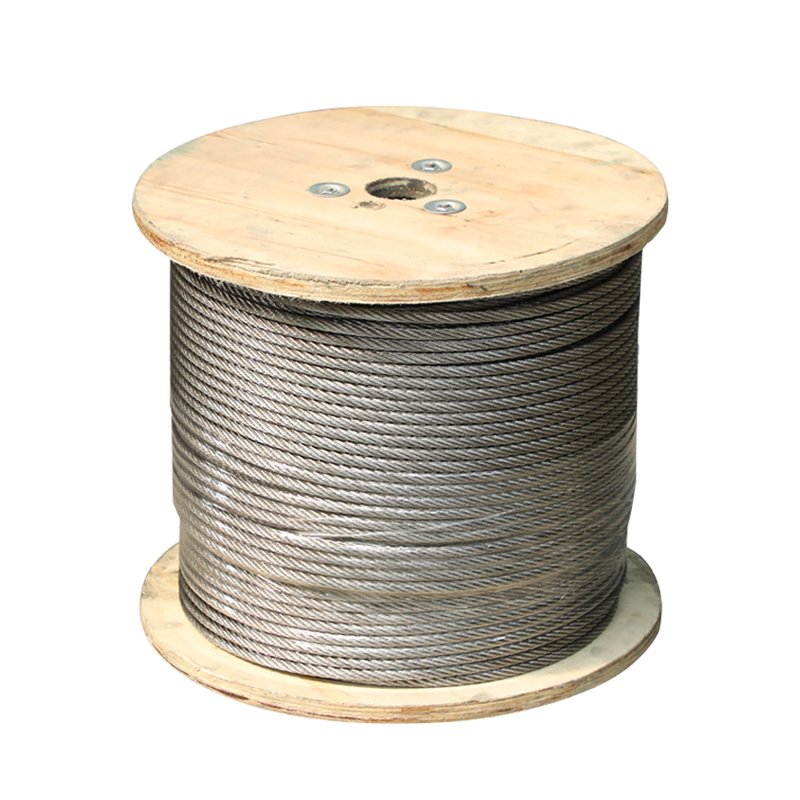
6x36WS-IWRC Stainless Steel Wire Rope Overview
6×36WS-IWRC stainless steel wire rope is a flexible, steel-core construction designed for applications requiring a balance of bending flexibility, abrasion resistance, structural stability and corrosion resistance.
The rope consists of six outer Warrington-Seale strands, each containing 36 stainless steel wires, laid around an independent wire rope core (IWRC). Compared with fiber-core constructions, the steel core provides improved support to the outer strands and better resistance to crushing, deformation and higher operating temperatures.
Guangtong Metal supplies AISI 304, 316 and 316L stainless steel options in diameters from 6 mm to 40 mm. Custom diameters, lay directions, reel lengths, lubrication, packaging and OEM production can be arranged according to the approved order specification.
This construction is commonly considered for marine winches, lifting equipment, industrial hoisting systems, cranes, pulling equipment and other applications involving repeated bending over drums or sheaves.
For lighter and more flexible cable assemblies, explore our 7×19 stainless steel wire rope. For submersible-pump suspension and applications requiring a polypropylene core, see our 6×19+PP stainless steel wire rope.
6×36WS-IWRC Construction
The designation 6×36WS-IWRC describes the principal rope construction:
- 6 indicates six outer strands.
- 36 indicates 36 individual wires in each outer strand.
- WS means Warrington-Seale strand construction.
- IWRC means Independent Wire Rope Core.
The Warrington-Seale arrangement combines different wire sizes within each strand. This allows the wires to fit together efficiently while providing a useful balance between flexibility and resistance to external wear.
The IWRC is a separate steel wire rope located at the center of the complete rope. It supports the six outer strands and helps the rope maintain its shape when subjected to radial pressure, loading on drums or repeated operation over correctly sized sheaves.
The actual performance of the rope depends on more than its construction designation. Diameter, material grade, tensile strength, lay direction, lubrication, sheave size, fleet angle, load spectrum and operating environment must all be considered.
Main Characteristics
Good Bending Flexibility
The relatively high number of wires in the outer strands makes 6×36WS-IWRC more flexible than many lower-wire-count constructions.
This flexibility makes it suitable for equipment where the rope repeatedly passes over drums and sheaves, provided that the equipment geometry is compatible with the selected rope diameter.
Steel-Core Support
The independent wire rope core provides stronger internal support than a fiber core. It helps the rope resist crushing and deformation when wound in multiple layers or subjected to pressure on a drum.
Abrasion Resistance
The Warrington-Seale strand design includes comparatively larger external wires. These outer wires help provide resistance to surface wear while the smaller internal wires contribute to flexibility.
Corrosion Resistance
Stainless steel provides corrosion resistance for wet, humid, marine and outdoor environments. The appropriate stainless steel grade should be selected according to chloride exposure, chemicals, temperature and maintenance conditions.
Dimensional Stability
The IWRC helps maintain the rope’s cross-sectional shape and supports the outer strands under load. This makes the construction suitable for industrial equipment requiring a steel-core rope with stable operating characteristics.
Stainless Steel Material Options
Guangtong Metal supplies 6×36WS-IWRC wire rope in AISI 304, 316 and 316L stainless steel.
AISI 304 Stainless Steel
AISI 304 provides general corrosion resistance and is commonly selected for indoor, outdoor and general industrial applications.
It may be considered when the operating environment does not involve severe chloride exposure or highly aggressive chemicals.
AISI 316 Stainless Steel
AISI 316 contains molybdenum and generally offers improved resistance to chloride-related corrosion compared with AISI 304.
It is commonly considered for marine, coastal, wastewater and other wet operating environments. Final suitability depends on the actual exposure conditions and maintenance program.
AISI 316L Stainless Steel
AISI 316L is a low-carbon version of 316 stainless steel. It may be specified when fabrication, welding or project documentation requires this particular grade.
Material grade alone does not determine rope capacity. Mechanical performance must be confirmed using the selected diameter, tensile grade and approved technical specification.
Typical Applications
Depending on the selected diameter, material, tensile grade and equipment design, 6×36WS-IWRC stainless steel wire rope can be considered for the following applications.
Marine Winches and Deck Equipment
AISI 316 or 316L versions may be considered for winches, deck machinery and other marine equipment exposed to moisture or salt-containing environments.
The complete system should be evaluated for corrosion, bending cycles, drum design, end fittings and inspection requirements.
Crane and Hoisting Equipment
The combination of flexibility and steel-core support makes 6×36WS-IWRC suitable for consideration in crane, hoist and lifting systems requiring repeated movement over drums or sheaves.
The rope must be selected according to the equipment manufacturer’s requirements and applicable safety regulations.
Industrial Winches
The construction can be used in industrial pulling and positioning systems where a flexible steel-core rope is required.
Drum groove dimensions, fleet angle, spooling arrangement and maximum line pull must be verified before installation.
Lifting and Material-Handling Systems
6×36WS-IWRC can be considered for material-handling equipment operating in wet, outdoor or corrosive environments.
The rope should not be selected only by diameter. Required minimum breaking load, working load, design factor and operating cycles must also be confirmed.
Wastewater and Water-Treatment Equipment
Stainless steel rope may be used in lifting, positioning and maintenance assemblies for water-treatment facilities.
The selected stainless steel grade should be compatible with the water chemistry, temperature, cleaning chemicals and inspection schedule.
Mining and Industrial Equipment
Where corrosion resistance and steel-core support are required, the rope may be evaluated for industrial pulling, lifting and handling equipment.
For abrasive environments, both external wire wear and internal fatigue should be included in the inspection program.
6×36WS-IWRC vs 6×19+PP vs 7×19
| Construction | Core Type | Relative Flexibility | General Selection Focus |
|---|---|---|---|
| 6×36WS-IWRC | Independent wire rope core | High | Winches, cranes, hoists and industrial equipment requiring steel-core support |
| 6×19+PP | Polypropylene core | Medium | Pump suspension and flexible industrial cable applications requiring lower weight |
| 7×19 | Wire strand core | High | Smaller cable assemblies, flexible routing and general-purpose cable applications |
The comparison above describes general construction characteristics only. Actual flexibility, breaking load and service life depend on diameter, wire size, tensile strength, rope quality and operating conditions.
For equipment using drums or sheaves, rope selection should also consider the recommended diameter ratio, groove profile, fleet angle and bending frequency.
IWRC vs Fiber Core
An independent wire rope core is made from steel wire strands. A fiber core is made from natural or synthetic fiber material.
Compared with a fiber-core rope, an IWRC construction generally provides:
- Better support for the outer strands
- Greater resistance to crushing and deformation
- Higher metallic cross-sectional area
- Improved dimensional stability
- Better suitability for elevated operating temperatures
A fiber core can provide lower rope weight and may offer different flexibility or lubricant-retention characteristics. The appropriate core should be selected according to the equipment and working conditions.
For submersible-pump suspension and lighter-duty applications, a polypropylene-core construction such as 6×19+PP stainless steel wire rope may be more suitable.
Lay Direction and Rope Selection
6×36WS-IWRC stainless steel wire rope can be supplied in different lay directions according to the equipment specification.
Common options include:
- Right Regular Lay
- Left Regular Lay
- Other lay arrangements subject to technical confirmation
Lay direction must match the drum, reeving system and equipment requirements. Installing a rope with the incorrect lay direction can affect spooling stability and operating performance.
Please provide the existing rope designation, equipment manual, drawing or rope sample when requesting a replacement product.
Sheave and Drum Considerations
The service life of a wire rope is strongly influenced by the diameter and condition of the drums and sheaves over which it operates.
Important considerations include:
- Sheave and drum diameter
- Groove diameter and profile
- Alignment of the reeving system
- Fleet angle
- Number of bending cycles
- Single-layer or multilayer spooling
- Rope tension during installation
- Lubrication and maintenance practices
Undersized sheaves increase bending stress and may reduce fatigue life. Damaged or incorrectly sized grooves can accelerate external wear and strand deformation.
Always follow the equipment manufacturer’s instructions and applicable engineering requirements.
Inspection and Maintenance
Wire rope should be inspected before installation and regularly during service.
Inspection items may include:
- Broken wires
- External wear and abrasion
- Corrosion or discoloration
- Diameter reduction
- Crushing or flattening
- Kinks and bends
- Strand distortion
- Birdcaging
- Heat damage
- Condition of end terminations
- Lubrication condition
Inspection intervals should reflect the equipment type, operating frequency, environment, loading and applicable safety requirements.
Remove the rope from service when it reaches the applicable rejection criteria. Do not continue operating a rope with significant deformation, corrosion, broken wires or damaged terminations.
Custom Reel Lengths and OEM Supply
Guangtong Metal supplies 6×36WS-IWRC stainless steel wire rope according to customer specifications and order quantities.
Custom requirements may include:
- Specified diameter
- AISI 304, 316 or 316L material
- Required tensile strength
- Right- or left-hand lay
- Specified reel length
- Wooden or plywood reels
- Export pallet packaging
- Customer labels
- OEM packaging
- Inspection and material documentation
Please provide all documentation and inspection requirements before production is confirmed.
For other structures and diameter ranges, browse our stainless steel wire rope range.
Frequently Asked Questions
What does 6×36WS-IWRC mean?
It means that the rope contains six outer Warrington-Seale strands, each with 36 wires, arranged around an independent wire rope core.
Is 6×36WS-IWRC flexible?
Yes. Its relatively high wire count provides good bending flexibility compared with many lower-wire-count constructions. Actual flexibility also depends on rope diameter and individual wire dimensions.
What is the advantage of an IWRC core?
The independent wire rope core supports the outer strands and improves resistance to crushing, deformation and elevated temperatures compared with many fiber-core constructions.
Is this rope suitable for marine applications?
AISI 316 or 316L may be considered for marine and coastal environments because of their improved resistance to chloride exposure. Suitability must still be evaluated using the actual environmental and operating conditions.
Can it be used on cranes and winches?
It can be considered for cranes, winches and hoisting systems requiring a flexible steel-core construction. Final selection must comply with the equipment manufacturer’s requirements, load calculations and applicable safety standards.
What diameters are available?
The listed supply range is 6 mm to 40 mm. Please confirm the required diameter, quantity and specification when requesting a quotation.
What tensile strengths are available?
Reference tensile strength options include 1570, 1770 and 1960 MPa. Availability depends on diameter, material grade and order requirements.
Is minimum breaking load the same as working load?
No. Minimum breaking load is not a safe working load. The working load must be determined using the required design factor, applicable regulations and complete equipment conditions.
Can you provide custom reel lengths?
Yes. Send us the required length per reel, total quantity and reel limitations. We will confirm the available packaging arrangement.
Can Guangtong Metal provide OEM packaging?
Yes. Customer labels, reel markings, export packaging and other OEM requirements can be arranged according to the confirmed order.
Request a Quote for 6×36WS-IWRC Stainless Steel Wire Rope
To receive an accurate quotation, please provide:
- Material grade
- Cable diameter
- Required minimum breaking load or tensile grade
- Length per reel and total quantity
- Application, drawing or end-fitting details
- Packaging requirements and delivery destination
Guangtong Metal will review your requirements and confirm the available specification, reel arrangement, production requirements and quotation.