
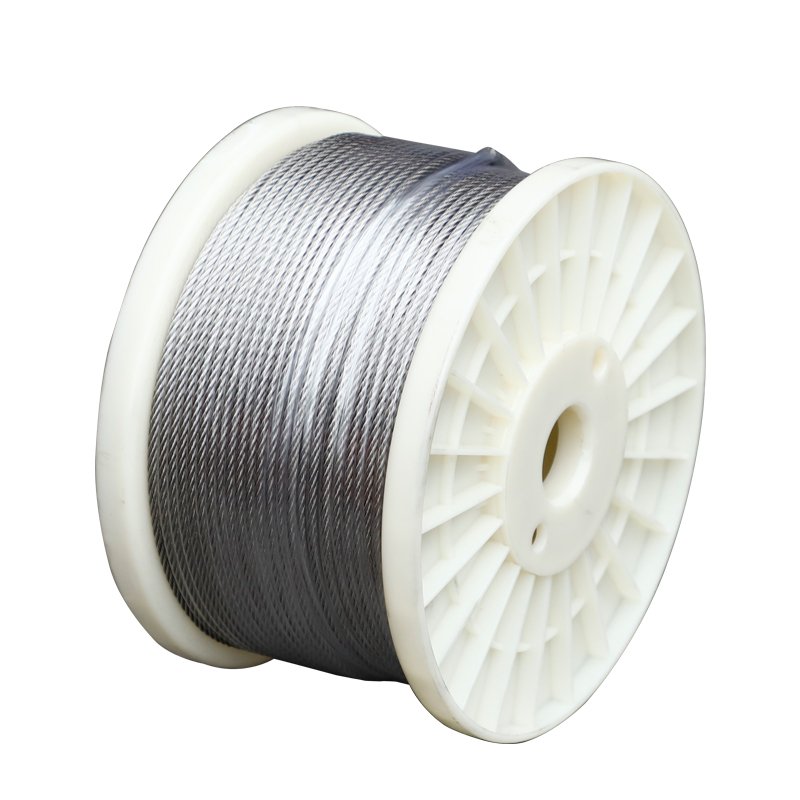
PTFE Coated Wire Rope Overview
PTFE coated wire rope, commonly searched for as Teflon coated wire rope, consists of a stainless steel or galvanized steel wire-rope core covered with a polytetrafluoroethylene protective layer.
PTFE is a high-performance fluoropolymer known for its broad chemical resistance, low coefficient of friction, low moisture absorption, electrical insulation and ability to retain useful properties across a wide temperature range. These characteristics make PTFE-coated wire rope suitable for specialized cable assemblies operating in chemically aggressive, high-temperature, clean or low-friction environments.
Guangtong Metal supplies PTFE-coated wire rope with AISI 304, AISI 316 or AISI 316L stainless steel cores, as well as galvanized steel options where appropriate. Common constructions include 1×7, 7×7 and 7×19, with other constructions available according to the required strength, flexibility and operating conditions.
Core diameter, finished coated diameter, coating thickness, construction, material grade, color, reel length, cut length and end fittings can be customized according to drawings and project requirements.
Terminology note: PTFE is the generic material name. Teflon™ is a trademark of The Chemours Company and should not be used as a generic material certification. A product should only be represented as using Teflon™ material when the actual resin source and applicable trademark requirements have been confirmed.
Advantages of PTFE Coating
PTFE coating is selected when standard plastic coatings such as PVC, PE or PP cannot meet the required chemical, temperature or friction conditions.
Key advantages include:
- Broad resistance to many industrial chemicals
- Low coefficient of friction
- Smooth, low-adhesion surface
- Very low water absorption
- Good electrical insulation properties
- Resistance to many oils, fuels and solvents
- Good performance over a wide temperature range
- Excellent weathering and UV stability
- Reduced accumulation of dirt and process residue
- Protection against direct contact with surrounding components
- Suitable for specialized industrial and precision cable assemblies
- Custom core materials, constructions and finished diameters
Actual performance depends on the fluoropolymer grade, coating process, coating thickness, steel core, lubricant, end fittings and operating conditions.
PTFE, FEP, PFA and ETFE Are Not the Same
The term “Teflon coated cable” is sometimes used loosely in the market to describe different fluoropolymer-coated products. However, PTFE, FEP, PFA and ETFE are different materials and should not be treated as interchangeable.
| Fluoropolymer | General Characteristics | Selection Considerations |
|---|---|---|
| PTFE | Very broad chemical resistance, low friction and high temperature capability | Specialized chemical, thermal and low-friction applications |
| FEP | Melt-processable, transparent or translucent and flexible | Cable jackets requiring easier extrusion and a smooth surface |
| PFA | Broad chemical resistance with melt-processability and high-temperature capability | High-purity and demanding chemical applications |
| ETFE | Strong, tough and abrasion-resistant | Cable systems requiring greater mechanical toughness |
Before describing a product as PTFE coated wire rope, the coating resin must be confirmed as PTFE. If the coating is FEP, PFA or ETFE, the product page and technical documents should use the correct polymer name.
Core Material Options
AISI 304 Stainless Steel
AISI 304 stainless steel provides good general corrosion resistance and mechanical performance for many industrial and indoor applications.
AISI 316 Stainless Steel
AISI 316 stainless steel provides improved resistance in humid, coastal and selected chemical environments.
AISI 316L Stainless Steel
AISI 316L has a lower carbon content than standard 316 and may be specified for applications requiring improved resistance to sensitization after welding or particular fabrication requirements.
Galvanized Steel
Galvanized steel may be used where mechanical strength and cost are the main considerations. Suitability depends on the operating environment and whether the galvanized surface is compatible with the specified temperature and chemical exposure.
PTFE coating does not eliminate the need to select the correct wire-rope core material. If the coating is damaged or removed at a termination, the underlying steel becomes exposed to the operating environment.
Available Wire Rope Constructions
1×7 Construction
The 1×7 construction consists of one central wire surrounded by six outer wires. It is relatively rigid and suitable for fixed cable assemblies, control elements and applications involving limited bending.
7×7 Construction
The 7×7 construction provides moderate flexibility and dimensional stability. It is suitable for general coated cable assemblies where a balance between strength and flexibility is required.
7×19 Construction
The 7×19 construction uses a greater number of smaller wires and offers higher flexibility than 1×7 and 7×7. It can be considered for applications involving repeated bending, subject to the pulley diameter and operating conditions.
Custom Constructions
Other constructions can be supplied according to technical drawings and project requirements. Selection should consider:
- Required breaking load
- Minimum bend radius
- Frequency of movement
- Resistance to crushing
- Surface abrasion
- Operating temperature
- Chemical exposure
- End-fitting design
Temperature Performance
PTFE is commonly selected for applications involving temperatures beyond the normal capability of PVC, PE and PP coatings. Many PTFE grades are used at continuous temperatures up to approximately 260°C, but this value must not automatically be applied to the completed wire-rope assembly.
The maximum and minimum operating temperatures of the finished cable may be limited by:
- Wire-rope lubricant
- Coating grade
- Coating thickness
- Adhesion or intermediate layer
- End fittings
- Crimping materials
- Seals and connectors
- Operating load
- Repeated bending
- Heating and cooling cycles
For high-temperature applications, customers should provide the normal operating temperature, peak temperature, exposure duration and required service life. Final temperature capability must be confirmed against the approved material and assembly specification.
Chemical Resistance
PTFE is highly resistant to many acids, alkalis, solvents, oils and industrial chemicals. This makes PTFE-coated wire rope suitable for selected chemical-processing and laboratory environments.
However, no general statement can replace an application-specific compatibility review. Customers should provide:
- Chemical name
- Chemical concentration
- Operating temperature
- Continuous or intermittent exposure
- Exposure duration
- Pressure or mechanical load
- Cleaning and sterilization methods
The resistance of the PTFE layer does not automatically mean that the entire cable assembly is chemically resistant. The wire-rope core, exposed ends, terminals, sleeves and lubricants must also be compatible with the environment.
Low-Friction and Non-Stick Surface
PTFE has a low coefficient of friction and a surface to which many materials do not easily adhere. This can help reduce sliding resistance and accumulation of process residue in suitable cable assemblies.
These properties may be beneficial for:
- Cable guides
- Control cable assemblies
- Laboratory equipment
- Processing machinery
- Clean industrial environments
- Components exposed to sticky or contaminating substances
PTFE coating should not automatically be treated as a substitute for lubrication. Friction performance depends on contact pressure, counter-surface material, temperature, speed and wear conditions.
Moisture, Weathering and UV Resistance
PTFE has very low moisture absorption and strong resistance to sunlight and outdoor weathering. Unlike standard PE or PP, PTFE generally does not require a separate UV-stabilizing additive to provide its characteristic weather resistance.
Nevertheless, outdoor performance of a completed cable still depends on:
- Coating continuity
- Coating thickness
- Mechanical damage
- Exposed wire-rope ends
- Terminal materials
- Galvanic interaction between metals
- Salt and chemical exposure
- Installation tension and movement
For coastal or marine environments, AISI 316 or 316L stainless steel is generally more appropriate than galvanized steel or AISI 304, subject to the complete application assessment.
Electrical Insulation
PTFE provides good dielectric performance and can electrically separate the steel cable surface from surrounding components.
Potential applications include:
- Instrumentation cable assemblies
- Electrical equipment mechanisms
- Control systems
- Test equipment
- Cable guides near electrical components
PTFE-coated wire rope should not automatically be described as an electrical cable or certified insulation system. Voltage rating, dielectric strength and insulation thickness require separate testing and approval.
Typical Applications
Depending on the selected core, construction and coating grade, PTFE-coated wire rope may be considered for:
- Chemical-processing equipment
- Laboratory and analytical instruments
- High-temperature cable assemblies
- Low-friction control cables
- Industrial automation equipment
- Clean-processing machinery
- Food-processing equipment, subject to compliance
- Pharmaceutical equipment, subject to validation
- Marine and coastal cable assemblies
- Electrical and instrumentation mechanisms
- Specialized OEM cable assemblies
Any use in food, pharmaceutical, medical, aerospace or other regulated applications requires the correct material declaration, traceability, testing and regulatory documentation. PTFE material properties alone do not establish regulatory compliance.
Food and Medical Application Notice
PTFE is widely used in industries requiring clean and chemically resistant components, but not every PTFE resin, pigment, additive or finished coated cable is approved for food contact or medical use.
Do not describe the product as:
- Food grade
- FDA approved
- Medical grade
- Biocompatible
- Sterilization approved
unless the specific raw material and completed product have the necessary declarations, testing and traceability.
For regulated applications, customers should state the required regulation or standard before quotation.
Coating Process and Dimensional Control
PTFE is not processed in exactly the same way as conventional melt-processable plastics such as PE and PVC. The appropriate coating method depends on the PTFE grade, cable design and required finished dimensions.
Production requirements may include:
- Surface preparation
- PTFE extrusion or specialized coating process
- Sintering or thermal treatment
- Dimensional control
- Spark or continuity inspection
- Adhesion assessment
- Finished surface inspection
Because PTFE has naturally low surface adhesion, coating integrity and any required bonding system must be evaluated according to the application. A low-friction PTFE surface should not automatically be interpreted as strong adhesion to the underlying wire rope.
Diameter and Coating Specification
PTFE-coated wire rope is specified using two diameters:
- Diameter of the inner steel wire rope
- Finished outside diameter after PTFE coating
For example:
2 mm stainless steel wire rope coated to 3 mm
This means that the stainless steel wire-rope core has a nominal diameter of 2 mm and the completed coated cable has an approximate outside diameter of 3 mm.
A quotation request should specify:
- Core diameter
- Finished coated diameter
- Minimum coating thickness
- Dimensional tolerance
- Wire-rope construction
- Core material
- Required breaking load
- Operating temperature
- Chemical exposure
- Required length
The PTFE coating is not part of the metallic load-bearing cross-section and must not be included when calculating the cable’s breaking load.
Color Options
Natural PTFE is typically white or opaque. Other colors may be available depending on the coating grade, pigment system and production quantity.
Possible options include:
- Natural white
- Black
- Custom colors subject to technical confirmation
Adding pigments or other ingredients may change the material’s electrical, thermal, chemical or regulatory properties. Color requirements should therefore be confirmed together with the required performance and documentation.
PTFE vs Standard Plastic Coatings
| Coating | General Characteristics | Typical Selection Focus |
|---|---|---|
| PTFE | Broad chemical resistance, low friction and high-temperature capability | Specialized chemical, thermal and clean applications |
| PU | Flexible, elastic and abrasion-resistant | Fitness equipment and repeated pulley movement |
| PA/Nylon | Tough and wear-resistant | Invisible grilles and industrial cable assemblies |
| PE | Low water absorption and economical | Engineering and outdoor galvanized wire rope |
| PVC | Flexible, economical and available in many colors | General-purpose coated cables |
| PP | Lightweight and resistant to many common chemicals | Agricultural and light-duty industrial cables |
PTFE is not automatically the best choice for every coated wire rope. Where high abrasion resistance and continuous pulley movement are the main requirements, PU coated wire rope or PA nylon coated wire rope may be more appropriate. PTFE is primarily selected for chemical, thermal, electrical or low-friction performance.
Custom Supply and OEM Service
Guangtong Metal supplies PTFE-coated wire rope according to drawings and project requirements.
Customization options include:
- AISI 304, 316 or 316L stainless steel core
- Galvanized steel core
- 1×7, 7×7 and 7×19 constructions
- Custom core and finished diameters
- Specified coating thickness
- Natural white, black or confirmed custom colors
- Specified reel length
- Cut-to-length cables
- Custom end fittings
- Customer labels
- OEM packaging
- Coil, reel or pallet packaging
Raw-material certificates, inspection reports and application-specific documentation should be requested before the order is confirmed.
End Fittings and Finished Assemblies
PTFE-coated wire rope can be supplied as bulk cable or manufactured into finished cable assemblies.
Available processing may include:
- Cut-to-length cables
- Looped ends
- Thimbled eyes
- Crimped terminals
- Threaded fittings
- Ball-end fittings
- Stops and sleeves
- Custom machined terminals
The coating may need to be removed from the termination area so the fitting can engage correctly with the load-bearing wire rope. The removal length and termination process should be defined by the approved drawing.
For high-temperature or chemically aggressive environments, the terminal, sleeve and fitting materials must be compatible with the same operating conditions as the cable.
Inspection and Quality Control
Inspection can be arranged according to the approved order specification and may include:
- Core wire-rope diameter
- Finished coated diameter
- Coating thickness
- Dimensional tolerance
- Surface appearance
- Coating continuity
- Wire-rope construction
- Material grade
- Cable length
- Breaking-load testing
- End-fitting pull testing
- Packaging and labeling
- Raw-material documentation
Additional testing for temperature, chemical exposure, electrical insulation or regulatory compliance must be agreed before production.
Minimum breaking load is not the same as working load limit. The working load and safety factor must be determined according to the completed assembly and application requirements.
FAQ
What is PTFE coated wire rope?
It is a stainless steel or galvanized steel wire rope covered with a PTFE fluoropolymer layer. It is used when chemical resistance, temperature capability, low friction or electrical insulation is required.
Is PTFE the same as Teflon?
PTFE is a generic polymer name. Teflon™ is a trademark owned by The Chemours Company and covers specific branded fluoropolymer products. Not every PTFE-coated cable should be described as a Teflon™ product.
Is every fluoropolymer-coated cable made from PTFE?
No. Some products sold informally as “Teflon coated” may use FEP, PFA or ETFE. The exact coating resin should be confirmed from the material specification.
What temperature can PTFE-coated wire rope withstand?
Many PTFE grades are used at continuous temperatures up to approximately 260°C, but the safe temperature of the completed cable may be lower because of the lubricant, fittings, coating process and mechanical load. The final limit must be confirmed for each assembly.
Is PTFE resistant to all chemicals?
PTFE has broad chemical resistance, but the complete assembly must be reviewed. Exposed steel, fittings, sleeves, lubricants and seals may have different chemical limitations.
Is PTFE-coated wire rope suitable for repeated pulley movement?
It may be suitable for certain moving assemblies, but PTFE is normally selected for low friction, chemical resistance or temperature performance rather than maximum abrasion life. PU or PA coating may be more appropriate for high-frequency pulley movement.
Is PTFE coating suitable for outdoor use?
PTFE has excellent inherent resistance to sunlight, moisture and weathering. The complete cable’s outdoor durability still depends on coating integrity, steel-core material, exposed ends and fittings.
Is the product food grade or FDA compliant?
Only when the specific resin, pigment, additives and finished product meet the required regulation and supporting documentation is available. PTFE alone does not automatically make a cable food-contact compliant.
Can you supply custom diameters and end fittings?
Yes. Core diameter, finished diameter, coating thickness, construction, cut length and end fittings can be customized according to drawings and order requirements.
Request a Quote for PTFE Coated Wire Rope
To receive an accurate quotation, please provide:
- Wire rope core material
- Wire rope construction
- Core diameter
- Finished coated diameter
- Indoor or outdoor application
- UV stabilization requirement
- Coating color
- Length per reel
- Total quantity
- Packaging requirements
- Delivery destination
Guangtong Metal will review the application and confirm the appropriate core material, construction, fluoropolymer grade, dimensions and production requirements.
Guangtong Metal will review your requirements and confirm the appropriate wire rope core, PTFE coating, reel arrangement and quotation.