
Short Answer: Which Construction Should You Choose?
Choose 7×7 stainless steel wire rope when you need a balanced construction for architectural, support, fixed or low-cycle cable assemblies. Choose 7×19 stainless steel wire rope when the cable must accommodate more bending, routing or controlled movement, such as pulley, sheave, control and equipment cable systems. On GuangTong’s current product pages, 7×7 is listed as a 6×7+WSC construction with moderate flexibility, while 7×19 is listed as seven strands of nineteen wires, 133 wires in total, with higher flexibility. Both constructions are offered in AISI 304, 316 and 316L options. Construction alone does not determine the safe working load: confirm diameter, material grade, core, rope grade, end fittings, operating environment and movement conditions before ordering.
7×7 vs 7×19 stainless steel wire rope Comparison
| Selection factor | 7×7 stainless steel wire rope | 7×19 stainless steel wire rope |
|---|---|---|
| Material options listed on the current product pages | AISI 304, 316 and 316L | AISI 304, 316 and 316L |
| Construction | 6×7+WSC, commonly referred to as 7×7 on the product page | Seven strands of nineteen wires; 133 wires in total |
| Relative flexibility | Moderate flexibility with useful shape stability | Higher flexibility for routing and controlled movement |
| Current listed diameter range | 0.36–16.0 mm | 1.0–26.0 mm |
| Typical selection focus | Architectural cable systems, support, tensioning, fixed or low-cycle assemblies | Pulleys, sheaves, control cables, fitness equipment, marine equipment and moving cable systems |
| What to confirm before purchase | Diameter, material grade, construction, core, rope grade, finish, length and fittings | Diameter, material grade, core, rope grade, pulley/sheave details, operating cycles, finished length and fittings |
| Breaking-force selection | Confirm for the selected diameter, material and rope grade | Confirm for the selected diameter, material and rope grade |
| Supply formats | Cut lengths, coils, reels and agreed packaging | Cut lengths, coils, reels and customized assemblies |
The size ranges above are the ranges currently listed on the corresponding GuangTong product pages. They are not a universal limit for every material or order specification. Final availability should be confirmed against the quotation and approved technical data.
The Structural Difference in Plain Language
What 7×7 Means
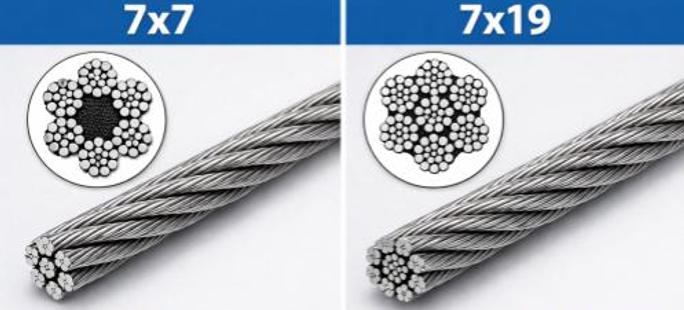
The 7×7 product page identifies the construction as 6×7+WSC: six outer strands, each containing seven wires, arranged around a wire-strand core. The product page commonly refers to this configuration as 7×7.
This construction is a practical starting point when the project needs a compact stainless steel cable with moderate flexibility and stable handling. It is often considered for architectural, support and general cable assemblies where the rope is fixed or moves only occasionally.
See the 7×7 stainless steel wire rope product page for the current construction description and product-specific reference data.
What 7×19 Means
The 7×19 construction contains seven strands of nineteen wires, giving 133 wires in total. The current 7×19 product page describes the central strand as the wire-strand core.
More, finer wires generally give the construction greater flexibility than 7×7 at comparable diameters. That makes 7×19 a more suitable starting point for cable routing, pulley and sheave systems, mechanical control cables and other applications involving bending or movement. The final selection still depends on the equipment and operating conditions.
See the 7×19 stainless steel wire rope product page for the current 133-wire construction, listed size range and reference technical table.
How Flexibility Changes the Application
The most useful difference between 7×7 and 7×19 is not simply the number of wires. It is how the construction behaves when the cable is routed, bent, terminated or installed in equipment.
Choose 7×7 as the Starting Point When:
- The cable is mainly fixed or under controlled tension.
- The project is an architectural, support or general industrial assembly.
- Moderate flexibility and stable handling are sufficient.
- The design uses compatible fittings and does not require frequent bending.
For cable railing and architectural systems, review the cable railing systems application page together with the complete railing design, end fittings and installation environment.
Choose 7×19 as the Starting Point When:
- The cable must travel around a pulley, sheave or drum.
- The application involves controlled movement or repeated routing.
- A mechanical control cable or flexible equipment assembly is required.
- Marine, fitness-equipment or machinery routing makes flexibility important.
For marine or outdoor equipment, also review the marine rigging solutions page and provide the operating environment when requesting a quotation.
Flexibility by itself is not enough to approve a design. Pulley diameter, groove, operating load, movement frequency, bend radius, cable travel, end fittings and the selected material grade all affect the final choice.
Material: 304, 316 or 316L?
The current product pages list AISI 304, AISI 316 and AISI 316L options for both constructions. AISI 304 is commonly considered for many general architectural and industrial environments. AISI 316 or 316L is generally considered when the cable is exposed to marine, coastal, humid or more aggressive conditions.
Material selection should be made against the actual exposure environment. Tell the supplier whether the cable will be exposed to saltwater, coastal air, chemicals, outdoor moisture or cleaning agents. Do not select a grade based on construction alone.
Factory Experience: What Should Be Checked Before Quotation?
In a factory quotation review, a common mistake is to choose 7×19 only because “more flexible” sounds better. The first question should be whether the cable will move, and if so, how it will move. The second question is whether the selected end fitting and equipment geometry are compatible with the cable.
GuangTong’s current manufacturing information describes a review process covering agreed material, size, construction, finish, documents and packaging. It also lists raw-material and specification review, in-process dimensional checks, final product and packing inspection, and order-specific documents when confirmed.
The company currently presents itself as a manufacturer with 20+ years of manufacturing experience, exports to 80+ countries, OEM custom production and quality control before shipment. These are supplier capabilities; they should not be presented as a guarantee of performance for an unspecified rope or application.
For a useful supplier review, send a drawing, sample, equipment photo or installation dimensions when available. This helps the factory distinguish a fixed architectural cable from a moving control or pulley application before quoting.
Production, Inspection and Packaging Photos
Use real images from the current GuangTong website and product galleries in this News article. Upload or select the existing media files in WordPress rather than using stock images.
Recommended image placement:
- Featured image: 7×19 stainless steel wire rope product photo.
- After the comparison table: 7×7 and 7×19 structure diagrams or product close-ups.
- Factory experience section: production and industrial application image from the company website.
- Quality section: the existing qualification / document image only if the image is current and publicly approved for reuse.
- Packaging section or closing CTA: real reel, coil or export-packaging photo from the product gallery.
Suggested ALT text should describe each image specifically, for example:
7x19 stainless steel wire rope product on reel7x7 and 7x19 stainless steel wire rope structure comparisonGuangTong wire rope production and industrial application imageGuangTong wire rope quality documents and inspection imagestainless steel wire rope coil and reel packaging
Do not use an ALT text that claims a material grade, test result or certification unless that information is visible in the image and verified for the specific product.
Procurement Checklist: What Information Should You Send?
To compare 7×7 and 7×19 accurately, include:
- Nominal diameter
- Construction: 7×7 / 6×7+WSC or 7×19
- Material: AISI 304, 316, 316L or another specified grade
- Core type and rope grade, when required by the project
- Coating material and finished outside diameter, if a coated cable is needed
- Required length, reel length or total quantity
- Application and operating environment
- Pulley or sheave diameter and movement cycles, for moving cable systems
- End fittings, assembly drawing or termination method
- Packaging, labeling and inspection-document requirements
If you are not sure which construction fits the application, send the information through the Request a Quote page for a specification review. Fittings and complete assemblies can be included in the inquiry when required.
Final Recommendation
Start with 7×7 for a balanced, moderately flexible construction used in fixed, architectural, support and low-cycle assemblies. Start with 7×19 for higher flexibility, moving cable routing, pulley or sheave systems and control applications. Then confirm the selection using the complete specification: diameter, material, core, rope grade, operating load, bending conditions, end fittings and environment.
The correct choice is not simply “the construction with more wires.” It is the construction that matches the way the cable will be installed and used.